Gambling regulation
Gambling in the country:
Licensing
Local License:
KSA
Top payment systems
Payment Systems (January-March 2025):
Слоты по доли рынка
| Игра | Студия | Доля рынка |
|---|---|---|
| Pirots 4 | Elk Studios | |
| Sweet Bonanza | Pragmatic Play | |
| Gates of Olympus | Pragmatic Play | |
| Le Pharaoh | Hacksaw Gaming | |
| Sugar Rush 1000 | Pragmatic Play |
Affiliates receiving traffic
More about gambling regulation
Offline gambling is legal in the country, as well as online gambling, poker, online sports betting and horse racing.
In 2021, the state passed an internet gambling law that opened up the market for online operators.
Today, the industry is regulated by the Netherlands Gambling Authority (KSA).
The KSA is responsible for issuing licenses, enforcing regulations, preventing illegal gambling, and combating financial fraud and other criminal activities related to the gambling sector.
In October 2024, new deposit limits were introduced. The primary deposit limit for players between the ages of 18 and 24 is now $311 per month, and for players over the age of 24 it is now $727 per month.
In addition, users between the ages of 18 and 24 who wish to deposit more than $156 per month are required to undergo additional verification with the operator. For users over 24 years of age, the monthly deposit threshold after which additional verification is required is $312 per month.
In the Netherlands, all gambling advertising on TV, radio, in print media and in public places is completely banned. However, only non-targeted gambling advertising is banned on the Internet, which raises concerns among authorities about the potential increase in the risk of gambling addiction among young people.
In this regard, discussions have been initiated on a bill that would completely ban gambling advertising on the global network. This innovation may finally deprive licensed operators of competitiveness in comparison with illegal platforms.
About blocking and liability
High
Legislation:
Strict KSA rules, sponsorship bans and increased advertising controls
The activity of the authorities:
High
Risk of harassment of non-residents:
Medium
The risk in entering the country:
Low
Risk of extradition to the country:
High
Precedents (against non-residents):
Yes (KSA fines/penalties)
Comment on the level of risk:
The Netherlands is tightening advertising restrictions: sponsorship bans and heavy fines for affiliates who promote illegal sites. Foreign arbitrators should consider the Netherlands a «hot» jurisdiction and avoid targeting. The risk of extradition to the country is high - the Netherlands actively uses the European Arrest Warrant (EAW) mechanism for extradition requests from EU countries.
Blask.com data - index and top brands
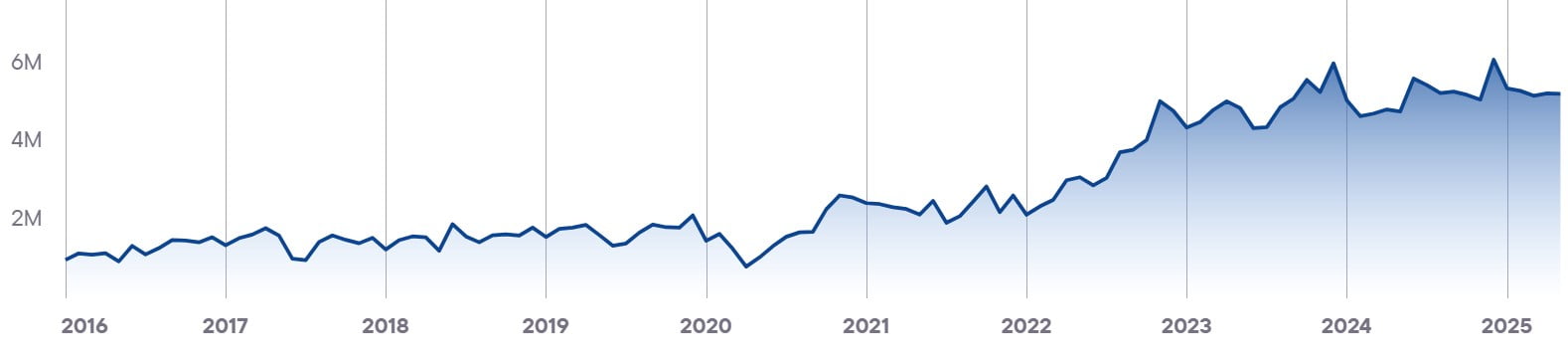
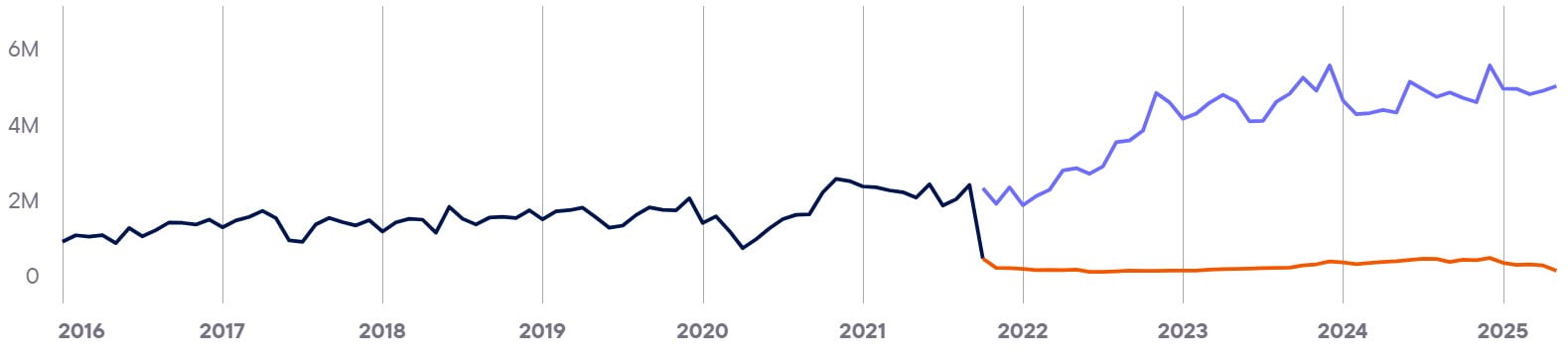
Indicates the aggregate level of engagement and interest in all brands in a country. This indicator serves as a barometer for the iGaming industry and combines various indicators to give an overview of trends and changes in the market.
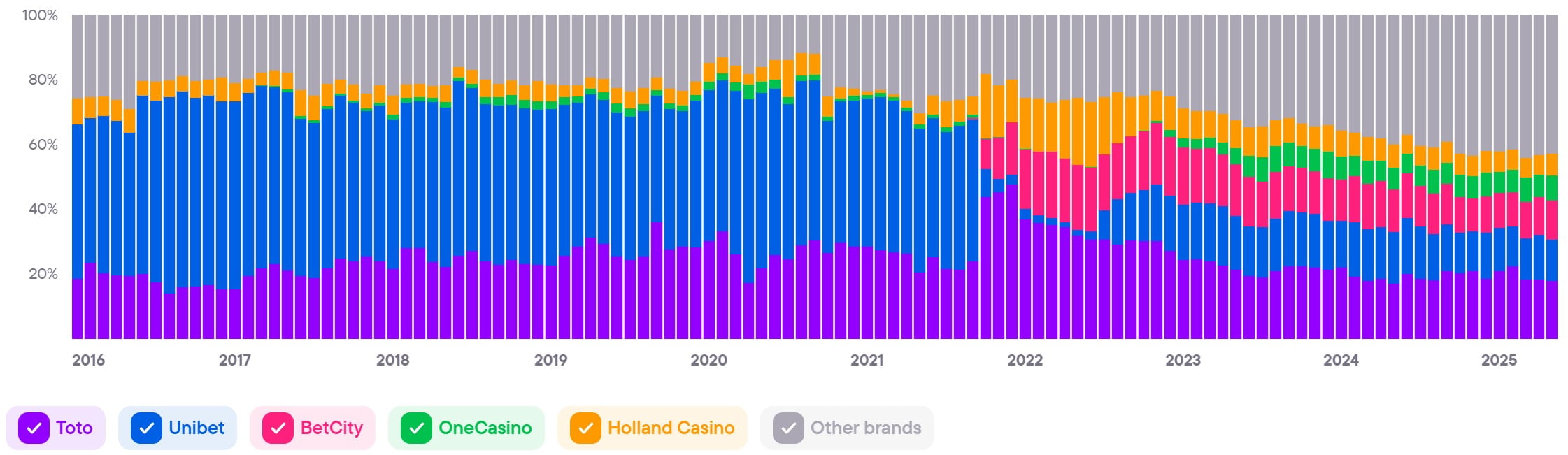
Top brands in the country according to the Blask.com service
| Toto | 14.81% |
| BetCity | 11.77% |
| Unibet | 11.56% |
| OneCasino | 7.81% |
| Holland Casino | 6.94% |
*BAP (Brand's Accumulated Power) - accumulated brand power, reflects the brand's share of consumer interest in the online gambling market. The relative presence of a brand in a country. The BAP graph is presented below:
Data for the section is provided by the analytical service Blask.com.. At the moment, the service's database contains information on more than 80+ countries and more than 2500 brands.
Gambling in the country
The Netherlands is a European country with a strong economy and a solvent population where gambling, both online and offline, is legal.
The sector is regulated by the Netherlands Gambling Authority (KSA), which adheres to strict requirements and restrictions for licensed operators.
In the near future, the KSA intends to completely ban gambling advertising of gambling games, which is still partially allowed.
Such tough conditions for operators are contributing to the growth of the black market, which attracts players with no deposit limits and strict user verification.
The regulator has already noted an increase in cash flows on illegal gambling sites. Thus, the financial consequences from the shadow sector are becoming more and more significant.
To date, the main goal of the authorities is to prevent the spread of gambling among young people.
The increase in the popularity of illegal sites, according to the government, indicates that current measures are not effective enough and that there is a need to strengthen controls on online gambling in the Netherlands.
It is likely that the legal industry will face total control and tightening of the adopted laws.
The population of the country is almost 18 million people. The country has a very high level of urbanization: more than 90% of Dutch people live in cities.
The increase in population started in 2015 and since then it has been growing by an average of 120,000 per year. This is largely due to the immigration factor.
The average age is 42 and the average life expectancy is just over 80 years.
As of 2024, the population had the following age distribution:
The male population is 49.7% and the female population is 50.3%.
The literacy level (ability to read and write) is 99%.
The national composition is as follows: Dutch 75.4%, EU citizens (excluding Dutch) 6.4%, Turks 2.4%, Moroccans 2.4%, Surinamese 2.1%, Indonesians 2%, others 9.3%.
Language: Dutch (official), West Frisian (spoken in the province of Friesland in the Netherlands), Papiamento (native language of Aruba, Curaçao and Bonaire).
Approximately 90%-93% of residents speak English, 71% speak German.
Religion: Atheists - 57%, Catholics - 17%, Protestants - 14.8, Muslims - 6%, other religions (including Hindus, Buddhists, Jews) - 5.2%.
Major citiesAmsterdam (capital), Rotterdam, The Hague, Utrecht, Groningen.
Currency: Since 2002 the monetary unit is the euro (EUR). 100 EUR = 103 USD.
The national employment rate is 82%, the unemployment rate is 3.7%, and the long-term unemployment rate is 0.5%.
The youth unemployment rate is almost 9%.
About 3.2% of the population is considered poor. Amsterdam (6.6%), Rotterdam (6.2%), The Hague (6.1%) and Vlieland (6.0%) have the highest poverty rates.
The average salary is $3800 and the minimum wage is $2700.
The three basic principles on which Dutch society is built are pleasure, comfort and friends.
Residents prefer things to be carefully planned and organized, with no surprises.
They rarely buy luxury goods and are more likely to invest in housing, avoiding buying unnecessary items.
The Dutch are not a hierarchical society. Here bosses and subordinates, elders and juniors, parents and children, students and teachers communicate as equals.
The population is not superstitious at all. For example, the number of flowers in a bouquet can be even or odd - no difference.
The humor in the country is sarcastic and direct. Some may find it primitive. There are practically no taboo topics here.
The inhabitants have a strong sense of self-esteem combined with a strong team spirit. The Dutch know the value of their opinions and are not afraid to express them.
Many maintain a small but close circle of friends. Therefore, residents do not feel the need to make an effort to make new acquaintances.
In the first half of 2024, the gross revenue of the legal online gambling sector was $781 million, an increase of 8% compared to the second half of 2023.
The number of game accounts in early 2024 grew to an average of 1.07 million per month, while the number of active players decreased to about 455k per month.
Online casinos dominate the sector, accounting for 72% of GGR. Online betting accounts for 7% of the total gambling market.
According to the Dutch Gambling Authority (KSA), illegal operators retain 13% of gross gambling revenue.
At the same time, it is likely that the government does not disclose the exact figures, as on average Dutch people google illegal platforms about 700 thousand times a month.
At the beginning of 2024, internet penetration was 99% and the number of internet users was over 17 million.
The average speed of wireless internet via Wi-Fi is 93.09 Mbps.
The average speed of mobile Internet connection is 19.88 Mbps.
Volume of device utilization:
Popular Web Applications: YouTube, Instagram, Facebook, TikTok, Facebook Messenger.
In January 2024, there are 15 million social media users in the Netherlands.
Number of active users in 2024:
Soccer is the most popular sport for betting. In addition, residents prefer tennis, ice hockey, cycling, basketball and cyber sports.
At online casinos, classic slots with fruit and sevens continue to be popular. Slots with pirates, Egyptian motifs and fantasy themes are also in demand.
Additional mini-games offering big wins and progressive jackpots are particularly enticing to residents.
Players prefer to use gambling apps instead of mobile versions of websites. In addition, the cryptocurrency market in the country is actively developing, which makes crypto-casinos especially in demand in this region.
KSA estimates that about 5% of the country's adult population and more than 22% of youth between 18 and 23 years old regularly participate in gambling.
CRUKS - is a special self-exclusion registry for gambling. The system was launched in 2021 and its main goal is to prevent gambling addiction.
A player can voluntarily register with CRUKS and restrict their access to legal online casinos. The minimum period of exclusion is 6 months.
To register in the system, players provide their BSN (unique personal number) and when registering at a legal online casino, his BSN is checked against CRUKS.
Illegal operators, do not require BSN when registering. Because of this, many CRUKS players continue to play in «gray» casinos. In recent years, «ford» has appeared among such players:
A player actively plays. After some time (usually when the amount of deposits exceeds several thousand), he turns to the support team and demands all his money back, claiming that the operator is illegal.
Players are manipulated into saying that they are registered with CRUKS and cannot play at online casinos and are threatened with legal action if they refuse refunds.
Another type of «frod» that is common among players from the Netherlands looks like this:
A player makes a minimum deposit to get a welcome bonus, loses money and self-excludes. If a player manages to self-exclude, further communication with him becomes impossible - he simply disappears, although the funds for his attraction have already been spent.
Many operators are fighting this type of freud by making it more difficult to self-exclude. In response, players threaten complaints and lawsuits.
Gambling regulation
Gambling in the country:
Licensing
Local License:
KSA
About the population of the country
Official Language:
Dutch
Believers:
26 %
Second Religion:
Basic information about the country
Name of country:
Netherlands
Code (2-digit):
NL
Continent:
Europe
Capital:
Amsterdam
Area of the country:
41,526 square kilometers.
Phone Code:
31
Currency (currency code):
Euro (EUR)
Geographical features of the country
Province (12): Gelderland, Groningen, Drenthe, Zeeland, Limburg, Overijssel, North Holland, North Brabant, Utrecht, Flevoland, Friesland, South Holland.
The modern territory of the country was partially or fully occupied by the following states: Roman Republic, Roman Empire, Frankish State (Frankia), Gallic Empire, Western Roman Empire, East Frankish Kingdom, Holy Roman Empire, Spanish Empire, French Empire, German Empire.
The Netherlands is washed by seas: North Sea, Watt Sea.
There are rivers running through the area: Rhine, Maas, Scheldt, Fechte, Dinkel, Zwarte-Water.
The Netherlands owns the islands: Curaçao, Bonaire, Aruba, Texel, St. Maarten, Terschelling, Ameland, Schiermonnikoog, Vlieland, Sint Eustatius.
Discussions on country characteristics
Any registered user can share their experience of working on this country with our community, tell about their «bumps in the road».
DICE.expert is an independent analytics platform for iGaming, SEO and digital marketing.
We collect data from official sources, structure information about markets, companies and technologies, and make the industry more transparent and understandable for professionals.
DICE.expert is not an online casino and does not provide access to gambling. All information is available for educational and analytical purposes only.
© 2024–2026 DICE.expert