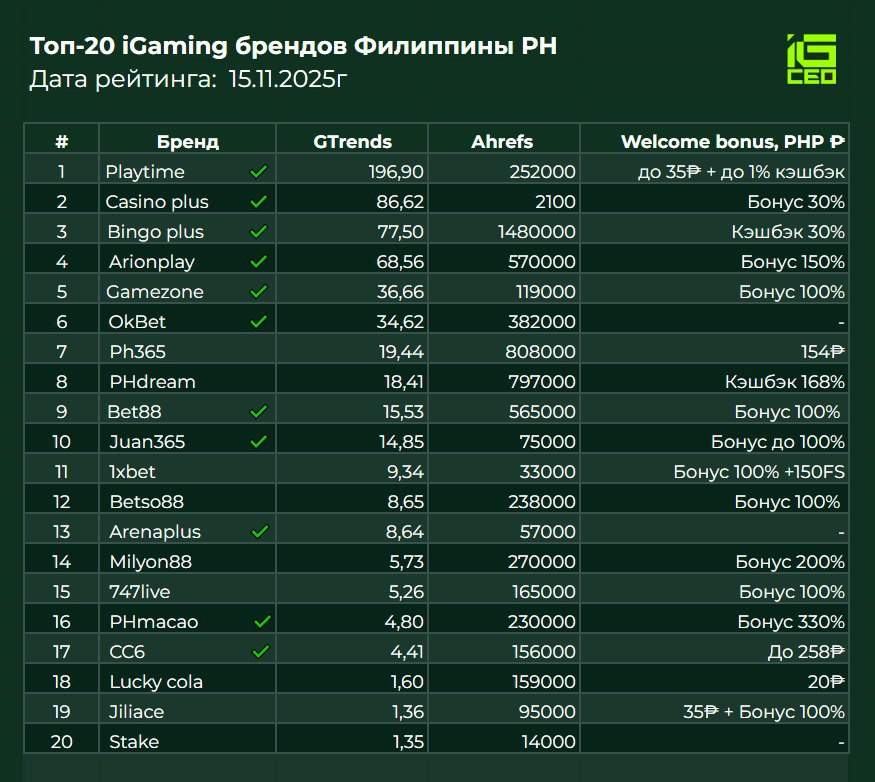
Brand Rating Philippines
Brand Playtime is ranked number one, Casino plus in 2nd, and the top three are rounded out Bingo plus. (Licensed brands are marked with a check mark ✅)
Brand Ambassador Playtime as of August 2025 is Heaven Peralejo - Filipino actress and influencer.
Brand Ambassador Casino plus as of April 2024 is Julia Barrett - Filipino actress and model, and Alden Richards - Filipino actor, singer, and television host.
Ambassador Bingo plus as of July 2024 is Kim Chiu - Filipino actress, singer, television host, and model.
Industry Regulation.
The Philippines is one of the most unique iGaming markets in Asia: gambling here is legal but strictly regulated. The main regulator is PAGCOR, which simultaneously licenses operators, controls the market and manages part of the casino. It controls land-based casinos, e-Games/e-Bingo and domestic online casinos (PIGO).
The second center is. CEZA, an offshore zone for interactive gaming focused on international markets. CEZA license doesn't give you the right to work for Filipino players and is used mainly by B2B companies and providers.
For a long time, the country has been a base for offshore operators (POGO), but in 2024-2025, the authorities banned this model completely and revoked the licenses.
Legal: PAGCOR land-based casinos, PIGO-operators, e-Games/e-Bingo.
Illegal: Online casinos without a PAGCOR license and foreign sites targeting Philippine players. (fountain)
Briefly on licensing:
PAGCOR (PIGO / in-house online casinos):
- registration fee: ~$ 8,500;
- annual license: from $ 254,000 or 1% GGR;
- regulatory fees: ~0.25% GGR;
- tax: 5% franchise tax.
CEZA (offshore / B2B):
- Master licensor: registration fee $500,000, license fee $10,000, renewal $10,000/year; (fountain)
Portrait of an iGaming player in the Philippines.
The major players are. men (in online betting up to 94%). The prime age is. 26-35 years (36%), then. 36-45 years (30%) and 21-25 years (16%). About 80% earn less than $340/month., of which 43% is below $170, forming a low- to lower-middle-income audience.
Profiles: couriers (21%), retail/sales (18%), laborers (15%), students/unemployed (18%). Education is mostly secondary or incomplete higher education.
Motivations: curiosity (33%), boredom (16%), desire for additional income (9%). In sports betting: 50% play for the sake of winning, 50% - for the sake of emotions. Impulsive bets and presence of high-risk group (frequent gamblers, borrowing money) are characteristic. (fountain)
Volume and dynamics of the iGaming market in the Philippines.
According to PAGCOR, the aggregate GGR of gambling in 2024 has reached ~$7.1 billion.
Of which. ~$2.63 billion - segment E-Games/iGaming (41-42% GGR).
For 2025, the forecast is as follows:
Common Market $7.65-8.16 billion, iGaming - $3.23-3.91 billion (40-45%). Less than 40% online gambling is legal, over 60% - offshore and unlicensed platforms, indicating a total market size 1.5 times higher than the official one. (fountain)
CPA rates.
On open CPA affiliate CPA affiliate offers for Philippines - $10-45: in-app $10-30, Facebook ~$12, SEO $20-45.
CICC v. Influencers.
The regulator Cybercrime Investigation and Coordinating Center (CICC) handed the police a list of ~30 Influencers, Those found to be promoting unlicensed platforms; those who refuse to remove content risk criminal prosecution. (fountain)
Conclusion:
The Philippines is one of the most structured iGaming markets in the region: rapid growth is combined with tight control. Demand is high, the audience is low-margin, and the dominance of gray operators creates a gap between the legal and actual market. The country remains a strong B2B hub in 2025, while B2C operates strictly in the PAGCOR model.